


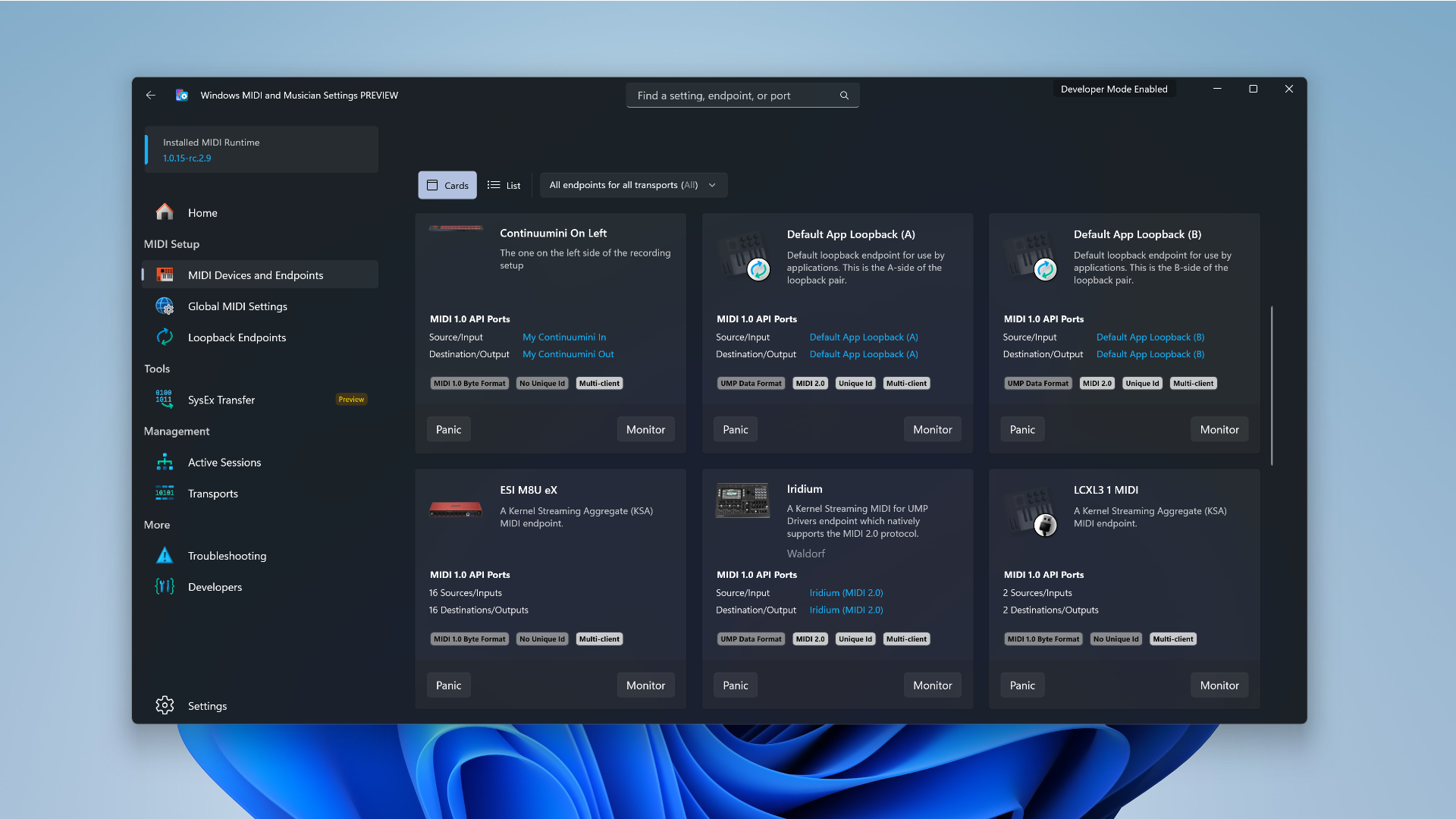
Key Points
- Windows 11 now supports MIDI 2.0 alongside MIDI 1.0 through Windows MIDI Services, providing enhanced features like automatic device discovery and higher resolution controls
- The update brings long-requested features including multi-client support allowing multiple applications to use the same MIDI device simultaneously, and improved endpoint naming customization
- Windows MIDI Services includes built-in loopback functionality for app-to-app communication and translation that enables MIDI 2.0 devices to work seamlessly with MIDI 1.0 software
Microsoft has announced the general availability of Windows MIDI Services, bringing both MIDI 1.0 and MIDI 2.0 support to Windows 11. This marks a significant advancement in the operating system’s music production capabilities, addressing decades-old limitations while preparing for the future of electronic music creation.
The new Windows MIDI Services architecture fundamentally changes how musicians interact with MIDI devices on Windows. All existing MIDI 1.0-aware software automatically benefits from enhanced features without requiring any updates, as the improvements are handled at the system level.
Key improvements include multi-client support, eliminating the previous restriction that only allowed one application to access each MIDI device. Musicians can now run multiple applications simultaneously, each sending and receiving MIDI data to the same hardware. The system also provides enhanced control over endpoint naming, allowing users to customize device names rather than being limited to generic manufacturers’ designations.
A particularly notable addition is the built-in loopback functionality, which enables applications to communicate with each other without requiring additional drivers. This integration extends to WebMIDI pages in browsers, creating a seamless ecosystem for music software. The loopback endpoints are automatically translated and made available to classic MIDI 1.0 APIs, ensuring compatibility across all software.
For users with newer MIDI 2.0 devices, Windows MIDI Services provides automatic translation and scaling. This means high-resolution MIDI 2.0 devices like the Yamaha Montage M, Roland A88 mk2, and others can work with both modern MIDI 2.0-aware applications and legacy MIDI 1.0 software. The system handles all necessary protocol translation and value scaling internally.
The update introduces precise timestamp support with accuracy to under one microsecond, enabling tighter synchronization for timing-critical applications. Developers can schedule messages for delivery at specific times, improving overall performance consistency across devices.
Microsoft developed Windows MIDI Services in collaboration with industry partners including Yamaha, Roland, Steinberg, and the Association of Musical Electronics Industry Japan (AMEI). The development process was conducted openly on GitHub with community involvement, allowing musicians and developers to follow progress and contribute feedback throughout development.
Microsoft plans to release additional tools and utilities for Windows MIDI Services in the coming months, including a MIDI Settings app and PowerShell scripting capabilities. Future enhancements in development include a low-latency USB audio driver with ASIO support, additional transport protocols like Bluetooth and Network MIDI 2.0, and a virtual patch bay for enhanced MIDI routing capabilities.
Windows MIDI Services represents Microsoft’s commitment to supporting musicians and audio professionals, providing a robust foundation that addresses current needs while enabling future innovations in electronic music production.
Read the rest: Source Link
You might also like: Try AutoCAD 2026 for Windows, best free FTP Clients on Windows & browse the best Surface Laptops to buy.
Remember to like our facebook and our twitter @WindowsMode for a chance to win a free Surface every month.