

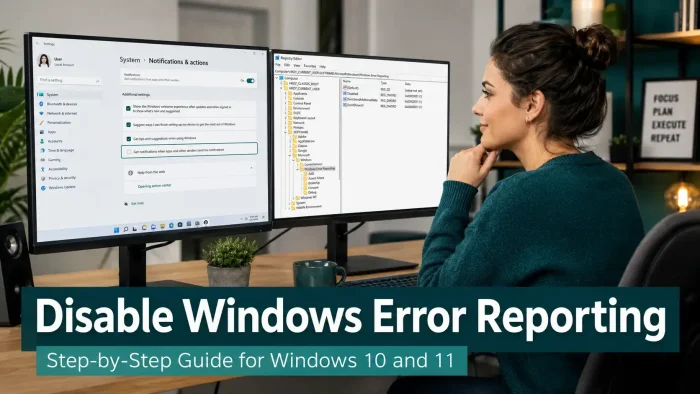

To disable Windows Error Reporting on Windows 11 or 10, you have three options: the Services app (services.msc), Group Policy Editor (gpedit.msc, Pro and Enterprise only), or Registry Editor (regedit). All three work without a reboot and can be reversed at any time. This guide walks through each method, plus PowerShell commands if you prefer the terminal.
3 methods covered
PowerShell included
What You Need to Know
- Group Policy Editor (gpedit.msc) is only available on Windows 10/11 Pro, Enterprise, and Education. Home users should use Services or Registry Editor.
- Disabling WER does not cause crashes or harm Windows. Your crash logs stay visible in Event Viewer. Nothing is hidden from you locally.
What Is Windows Error Reporting?
Windows Error Reporting (WER) is a built-in feature that watches for app crashes, freezes, and system errors. When something goes wrong, it collects details about what happened, such as which program crashed, what was running at the time, and basic system information, then sends that data to Microsoft over the internet.
Microsoft uses this to identify bugs and push fixes through Windows Update. You might want to disable it if you are on a slow or metered connection, work with sensitive data, or simply prefer not to send anything to Microsoft automatically.
Video: How to Disable Windows Error Reporting
Watch this walkthrough to see all three methods in action on Windows 10 and 11, including the Services app, Registry Editor, and Group Policy steps shown below.

Should You Disable Windows Error Reporting?
Good reasons to disable it
- You want to limit what data leaves your PC
- You are on a metered or slow connection
- Your PC handles sensitive business or personal data
- You run an offline or air-gapped system
Reasons to leave it on
- You want Microsoft to receive data that helps fix bugs
- You use it to troubleshoot crashes on your own PC
- Your IT team uses WER for internal diagnostics
- You are unsure. Leaving it on causes no harm.
How to Disable Windows Error Reporting
Pick the method that fits your Windows edition.
Services App (services.msc)
Works on all Windows editions, including Home
This is the quickest method. You are stopping the Windows Error Reporting Service so it no longer runs.
- Step 1. Press Win + R to open the Run dialog. Type
services.mscand press Enter. - Step 2. Scroll down the list and find Windows Error Reporting Service.
- Step 3. Right-click it and select Properties.
- Step 4. In the Startup type dropdown, select Disabled.
- Step 5. Click Stop to stop the service immediately if it is currently running.
- Step 6. Click Apply, then OK. Done.
Note: Setting the startup type to Disabled prevents the service from starting again after a reboot. If you only click Stop without changing the startup type, WER will restart the next time you reboot.
Group Policy Editor (gpedit.msc)
Windows 10/11 Pro, Enterprise, and Education only. Not available on Home.
Group Policy gives you centralized control over WER. On a single PC this method works the same as the registry, but it is cleaner to manage and easier to audit.
Home edition users: If you type gpedit.msc and get an error saying it cannot be found, your Windows edition does not include Group Policy Editor. Use Method 1 or Method 3 instead.
- Step 1. Press Win + R, type
gpedit.msc, and press Enter. - Step 2. In the left panel, navigate to: Computer Configuration > Administrative Templates > Windows Components > Windows Error Reporting.
- Step 3. In the right panel, double-click Disable Windows Error Reporting.
- Step 4. Select Enabled (this enables the policy that disables WER. The wording can be confusing).
- Step 5. Click Apply, then OK. The change takes effect immediately, no reboot needed.
Tip: The policy name says “Disable Windows Error Reporting” and you set it to “Enabled.” This is standard Group Policy wording. “Enabled” means the policy rule is active, which in this case means WER is disabled.
Registry Editor (regedit)
Works on all Windows editions, including Home
Registry warning: Editing the registry incorrectly can cause system problems. Follow these steps exactly. If you are unsure, use Method 1 (Services) instead. Consider exporting a backup of the key before making changes: File > Export in Registry Editor.
- Step 1. Press Win + R, type
regedit, and press Enter. Click Yes if prompted by User Account Control. - Step 2. In the address bar at the top, paste this path and press Enter:
HKEY_LOCAL_MACHINE\SOFTWARE\Microsoft\Windows\Windows Error Reporting - Step 3. In the right panel, look for a DWORD value named Disabled. If it does not exist, right-click an empty area in the right panel, choose New > DWORD (32-bit) Value, and name it Disabled.
- Step 4. Double-click Disabled. Set the value data to 1 and click OK.
- Step 5. Close Registry Editor. The change takes effect immediately, no reboot required.
What happens after you disable WER?
- Crashes still happen and are still logged in Event Viewer. Nothing is hidden from you locally.
- No crash data is sent to Microsoft.
- You will not see the “We’re sorry for the inconvenience” dialog after most crashes.
- Windows will not suggest automatic fixes based on your crash reports.
- Your PC performance is not affected at all.
How to Enable Windows Error Reporting
Changed your mind or need it back on for troubleshooting? Use the same method you used to disable it.
Via Services App
- Step 1. Press Win + R, type
services.msc, press Enter. - Step 2. Find Windows Error Reporting Service and double-click it.
- Step 3. Set Startup type to Manual (this is the Windows default).
- Step 4. Click Start to run the service now.
- Step 5. Click Apply, then OK.
Via Group Policy Editor (Pro/Enterprise only)
- Step 1. Press Win + R, type
gpedit.msc, press Enter. - Step 2. Navigate to Computer Configuration > Administrative Templates > Windows Components > Windows Error Reporting.
- Step 3. Double-click Disable Windows Error Reporting.
- Step 4. Select Not Configured or Disabled.
- Step 5. Click Apply, then OK. WER is active again immediately.
Via Registry Editor
- Step 1. Press Win + R, type
regedit, press Enter. - Step 2. Navigate to:
HKEY_LOCAL_MACHINE\SOFTWARE\Microsoft\Windows\Windows Error Reporting - Step 3. Find the Disabled DWORD value in the right panel.
- Step 4. Double-click it and set the value to 0. Alternatively, right-click and delete the value entirely. Both restore WER to its default state.
- Step 5. Close Registry Editor. No reboot needed.
Manage WER with PowerShell
PowerShell gives you a fast way to check and change WER without opening any settings window. These commands work on Windows 10 and 11. Run PowerShell as Administrator for the commands that make changes.
Check current WER status
Shows whether WER is currently enabled or disabled.
Get-WindowsErrorReportingCheck the WerSvc service status
Shows whether the Windows Error Reporting Service is running and how it is configured to start.
Get-Service -Name WerSvc | Select-Object Name, Status, StartTypeDisable WER via the built-in cmdlet
The cleanest PowerShell method. Sets the registry Disabled value to 1. Returns True on success.
Disable-WindowsErrorReportingEnable WER via the built-in cmdlet
Reverses the above. Sets the Disabled registry value back to 0. Returns True on success.
Enable-WindowsErrorReportingDisable WER via the service (stops and disables WerSvc)
Stops the service immediately and prevents it from starting on next boot.
Stop-Service -Name WerSvc -ForceSet-Service -Name WerSvc -StartupType DisabledEnable WER via the service (restores WerSvc to default)
Sets the service back to Manual startup (the Windows default) and starts it.
Set-Service -Name WerSvc -StartupType ManualStart-Service -Name WerSvcDisable WER via the registry directly
Sets the Disabled DWORD value to 1 using the registry path directly.
Set-ItemProperty -Path "HKLM:\SOFTWARE\Microsoft\Windows\Windows Error Reporting" -Name "Disabled" -Value 1 -Type DWordEnable WER via the registry directly
Sets the Disabled value back to 0 to re-enable reporting.
Set-ItemProperty -Path "HKLM:\SOFTWARE\Microsoft\Windows\Windows Error Reporting" -Name "Disabled" -Value 0 -Type DWordCheck current registry config
Shows the current values in the WER registry key so you can see exactly what is configured.
Get-ItemProperty -Path "HKLM:\SOFTWARE\Microsoft\Windows\Windows Error Reporting"Windows Server note: On Windows Server, use the Disable-WindowsErrorReporting cmdlet from the WindowsErrorReporting PowerShell module. The module is available by default on Server 2016 and later.
Windows Keyboard Shortcuts for This Task
These shortcuts open the tools you need directly without clicking through menus.
| Shortcut | What It Opens | Use It For |
|---|---|---|
Win + R |
Run dialog | Opens services.msc, regedit, or gpedit.msc |
Win + X |
Quick Access menu | Fast access to Device Manager, Event Viewer, PowerShell (Admin) |
Win + I |
Windows Settings | Access Privacy and Diagnostics settings |
Win + S |
Windows Search | Search for Services, PowerShell, Event Viewer by name |
Win + Pause |
System properties | Quick way to check your Windows edition (Home vs Pro) |
Ctrl + Shift + Esc |
Task Manager | Check if WerSvc or WerFault.exe is running |
Quick Reference: Method Comparison
| Method | Works on Home? | Reboot needed? | Skill level | Best for |
|---|---|---|---|---|
| Services (services.msc) | Yes | No | Beginner | Most users |
| Group Policy (gpedit.msc) | No (Pro/Enterprise only) | No | Intermediate | Managed PCs, IT admins |
| Registry (regedit) | Yes | No | Intermediate | Granular control |
| PowerShell | Yes | No | Intermediate | Scripting, remote management |
Tips for Getting This Right
Check your Windows edition before choosing a method
Press Win + Pause or search for “About your PC” in Settings. If it says Home, skip Group Policy and use Services or Registry instead.
Export a registry backup before editing regedit
In Registry Editor, navigate to the WER key, then go to File > Export. Save the .reg file somewhere safe. If anything goes wrong, double-click the file to restore it.
Run PowerShell as Administrator or the commands will fail
Right-click the Start button and choose Terminal (Admin) or Windows PowerShell (Admin). Registry and service changes require admin rights.
Use Event Viewer to see crash logs even with WER disabled
Press Win + X and select Event Viewer. Go to Windows Logs > Application and filter by Error or Critical. Your crashes are still logged there locally.
Re-enable WER temporarily if you are troubleshooting a crash
If an app keeps crashing and you cannot figure out why, turn WER back on for a day or two. The full crash report, including the dump file, can help you or the app developer identify the cause.
Frequently Asked Questions
Does disabling Windows Error Reporting affect PC performance?
Can I partially configure WER instead of fully disabling it?
HKLM\SOFTWARE\Microsoft\Windows\Windows Error Reporting has several values you can adjust. Set DontSendAdditionalData to 1 to send minimal data, or set Consent\DefaultConsent to 1 to make Windows ask before sending anything. This lets you keep error logging without automatic uploads.Does Windows 10 Home support Group Policy Editor?
What is the WerSvc service and is it safe to disable?
Can I re-enable Windows Error Reporting at any time?
Does disabling WER affect gaming on Windows?
Where are Windows Error Reporting logs stored?
%LOCALAPPDATA%\CrashDumps by default. You can paste that path into File Explorer to open it directly.Support and Community
- r/Windows10 on Reddit: community help for Windows 10 settings and issues
- r/Windows11 on Reddit: community help for Windows 11 settings and issues
- Windows Error Reporting documentation: official Microsoft developer reference for WER settings
More Windows software guides: How to take a screenshot on Windows · Disable Automatic Updates in Windows 11 · Fix Windows Error Code 0x80070005 · Fix Windows Error Code 0xC0000005