Microsoft used Ignite 2026 to pitch Azure as the place to run AI agents on your own terms. In a November 17 post, Arun Ulag, Executive Vice President of Microsoft Azure, listed new Arm servers, two PostgreSQL databases, app tools in Microsoft Fabric, agents that help run your cloud, and a new context platform called Microsoft IQ.
Some of it is ready today. Some is still in preview, which means it can change and is usually not meant for production yet. Here is what each piece does, its release stage, and where to start.
Key takeaways
- Ready now: Azure Cobalt 200 VMs, Azure HorizonDB, Fabric apps, Database Hub in Fabric, the Azure Copilot deployment agent and Azure Monitor health models.
- Still in preview: Fabric HorizonDB, Azure SRE Agent enterprise controls, Azure Workload Center and app building in Copilot with Fabric.
- Cobalt 200: up to 50% faster than Cobalt 100, in 14 regions now and 23 by the end of 2026.
- Billing: Fabric gets Copilot Credits, a new pay-for-what-you-use option.
- Microsoft IQ: Microsoft says nearly 60,000 customers already use it.
Available now or preview? The full list
The release stage decides whether you can put a feature into production this week or only test it. This is every Azure and Fabric item in Microsoft’s post, with the stage Microsoft gave it.
| Feature | What it does | Status |
|---|---|---|
| Azure Cobalt 200 VMs | Microsoft’s own Arm-based general-purpose virtual machines | Available now |
| Azure HorizonDB | Managed PostgreSQL-compatible database with built-in vector search | Available now |
| Fabric HorizonDB | Serverless PostgreSQL inside Microsoft Fabric | Preview |
| Database Hub in Fabric | One place to watch and manage databases in Azure, on-premises and Fabric | Available now |
| Fabric apps | Build and run governed apps on top of Fabric data | Available now |
| App building in Microsoft Copilot with a Fabric backend | Describe an app, use Fabric for databases, storage and data APIs | Frontier preview |
| Agentic app creation in Power BI Desktop | Turn existing semantic models into interactive apps | Preview |
| Copilot Credits for Fabric | A usage-based billing option next to capacity pricing | New, no stage given |
| Azure Copilot deployment agent | Turns plain-language requirements into deployed cloud workloads | Available now |
| Azure Monitor health models | Gives agents a live view of your app architecture and priorities | Available now |
| Azure SRE Agent enterprise controls | Controls for using SRE Agent in production | Preview |
| Azure Workload Center | Agentic operations for Oracle and SAP | Limited preview |
| Azure Catalyst | Agent-led modernization of apps, code and databases | New, no stage given |
| Microsoft IQ business plugins | Reusable business context, skills and tools for agents | Frontier preview |
Two items got no stage at all. Microsoft is “introducing” Copilot Credits and calls Azure Catalyst a new experience, without saying whether either is in preview or fully released.
An AI foundation you still control
The big idea is what Microsoft calls the Azure AI core. New compute, storage and networking now come together as one foundation for AI. You can build in Microsoft Foundry if you want Microsoft to manage the details, or run on Azure Kubernetes Service (AKS) when you need more control over performance, security and cost.
According to Microsoft, Azure sets up and tunes the infrastructure, places workloads where capacity is free so GPUs go further, and applies security rules centrally across agents, models and tools. It is built on open-source projects, so workloads can move, including to your own servers outside Azure.
Microsoft also repeated a capacity claim Satya Nadella shared at Build in June: Azure added more datacenter capacity in 18 months than in its first ten years.
In their words
“With the same frontier models available to everyone, the advantage comes from what no one else has: your context.”
Arun Ulag, Executive Vice President, Microsoft Azure, on the Microsoft Azure Blog
Azure Cobalt 200 VMs are generally available
Cobalt 200 is the second generation of Microsoft’s own Arm processor for Azure. The new virtual machines are built for scale-out, cloud-native and AI agent workloads, and Microsoft says they deliver up to 50% better CPU performance than Cobalt 100.
In the Cobalt 200 launch post, Microsoft’s own benchmarks show gains over Cobalt 100 of up to 1.5x for web serving, 1.6x for Java apps, 1.5x for AI agent tool execution and 1.9x for databases. Those are Microsoft’s numbers, so test your own workload before you plan around them.
Where
14 Azure regions today, growing to 23 by the end of 2026.
New VM families
Mpsv4 for memory-heavy work and Lpsv5 for fast access to large datasets.
How to deploy
Portal, Azure CLI, PowerShell, SDKs and APIs, plus Virtual Machine Scale Sets and AKS node pools.
Windows users, check this first
Microsoft’s supported list is mostly Linux (AlmaLinux, Azure Linux, Debian, Oracle Linux, Red Hat Enterprise Linux, Rocky Linux, SUSE and Ubuntu). The only Windows entry is Windows 11 client. Windows Server is not on the list, so check Arm support for your apps before you move them.
For a real-world test, see how Microsoft’s chip designers got up to 4x faster runs in our post on Cobalt 200 for chip design workloads.
Two homes for PostgreSQL: Azure HorizonDB and Fabric HorizonDB
PostgreSQL is the popular open-source database many developers now pick first. Microsoft is giving it two homes, and the difference is mostly about what you are building.
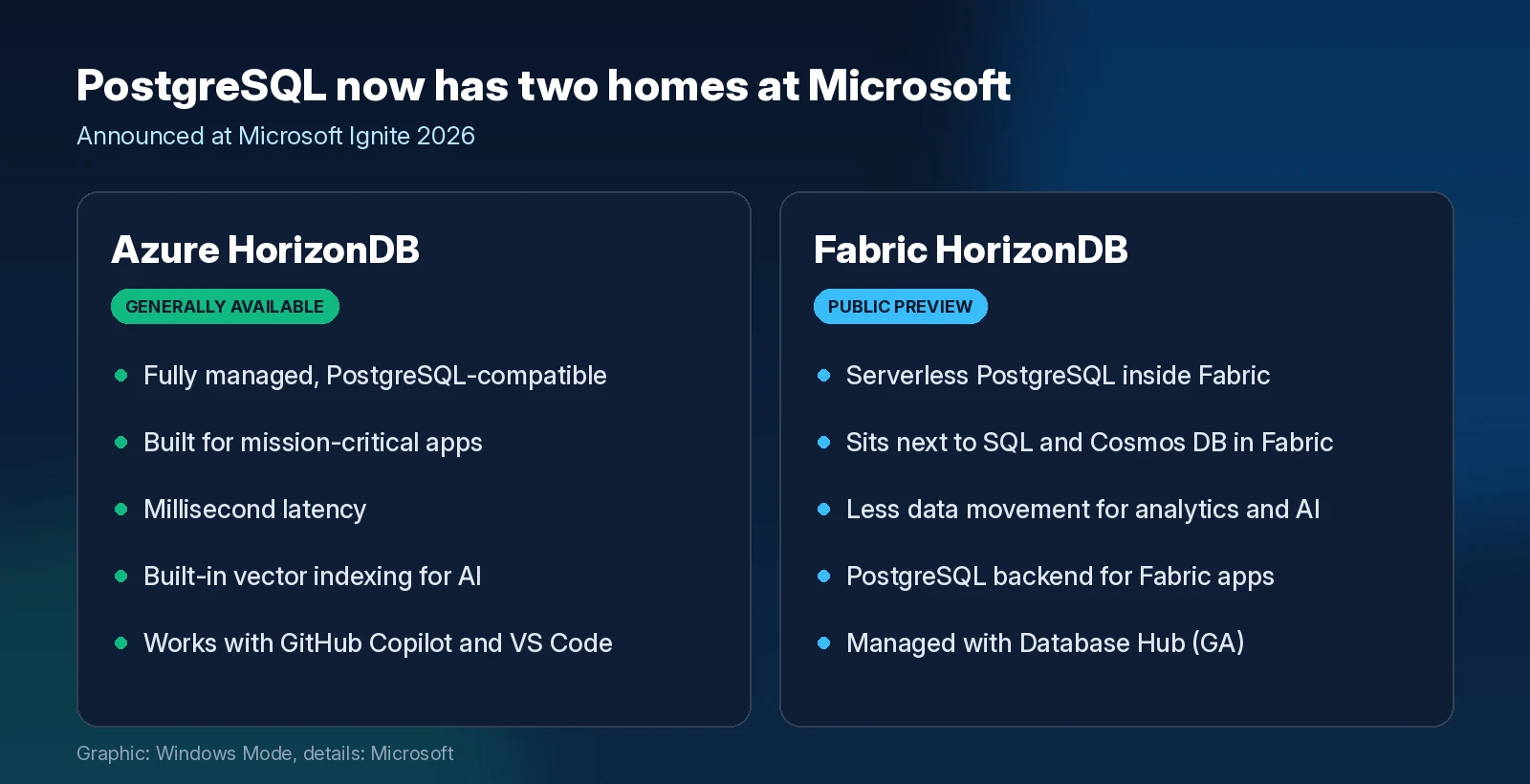
Azure HorizonDB is generally available. It is a fully managed, PostgreSQL-compatible database with millisecond latency and built-in vector indexing (a way to search data by meaning, which AI apps rely on). Developers can work with it in GitHub Copilot and Visual Studio Code.
Fabric HorizonDB is in public preview. It is a serverless PostgreSQL option inside Microsoft Fabric, next to SQL database and Cosmos DB in Fabric, so apps and analytics share data with less copying. It will also be the PostgreSQL backend for Fabric apps.
To keep track of all of it, Database Hub in Fabric is now generally available. It shows databases across Azure, on-premises servers and Fabric in one place, with Fabric Copilot pointing out what needs attention.
Fabric apps, and a new way to pay for Fabric
Fabric apps is now generally available. It gives apps the backend services they need, direct access to trusted data in Fabric, built-in security and governance. Developers and coding agents write the app with open-source tools, and Fabric sets up everything from databases to sign-in, with no servers to manage.
Build from a description Frontier preview
A new Microsoft Copilot integration lets anyone describe the app they need, with Fabric as an optional ready-made data backend.
Apps from Power BI Preview
Power BI Desktop can turn existing semantic models into interactive apps that capture input and update data.
Copilot Credits New, no stage given
A usage-based billing option for Fabric that sits alongside the existing capacity-based options.
Agents that help build and run your cloud
Microsoft calls this agentic operations: AI agents that watch your systems, suggest fixes and help act on them, with people kept in control. Two pieces are ready now, and two are still being tested.
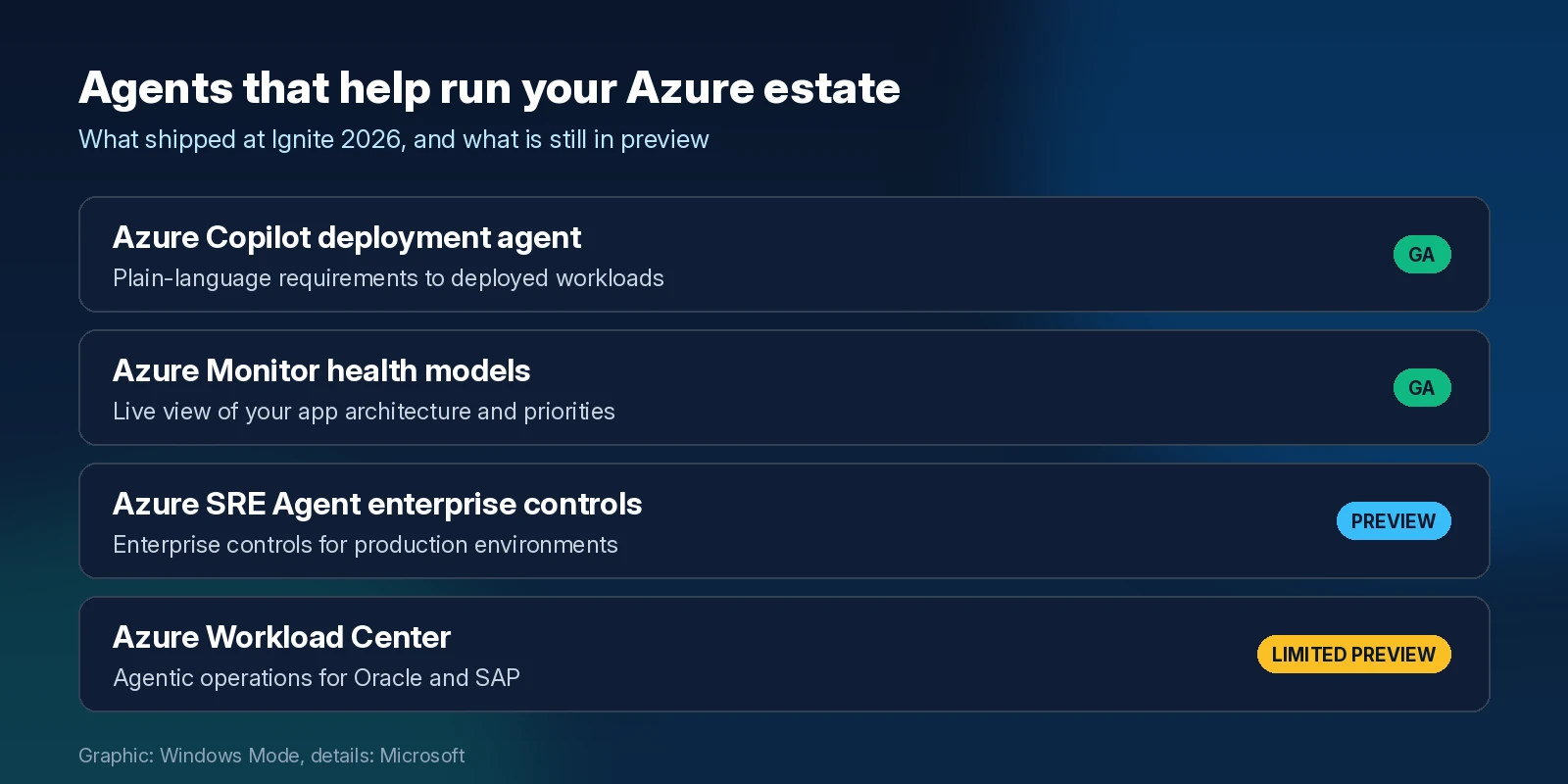
- Azure Copilot deployment agent (available now): describe what you need in plain language and it helps you get to a deployed cloud workload.
- Azure Monitor health models (available now): give agents a real-time view of your app architecture and business priorities, so they can recommend fixes.
- Azure SRE Agent (new controls in preview): brings these agents into secure production environments. Microsoft Entra Agent ID and Agent 365 help central teams find, govern and audit agents.
- Azure Workload Center (limited preview): extends the same approach to Oracle and SAP systems.
Azure Catalyst for modernizing older apps
Azure Catalyst is a new single place for moving and upgrading older apps, code and databases. It brings discovery, planning, migration, modernization and code analysis together, so IT teams and developers work from the same plan.
For developers, GitHub Copilot modernization carries that plan into code, with rulebooks for how agents behave and support for bringing your own AI model. Catalyst also works with Microsoft Security tools to rank vulnerabilities, flag which old code and databases to fix first, and let GitHub Copilot turn those findings into fixes.
Microsoft IQ: one source of business context for every agent
Agents are only as good as what they know about your company. Microsoft IQ is Microsoft’s new platform for collecting that knowledge once and reusing it in every agent and app.
It brings together Work IQ, Fabric IQ, Foundry IQ, Web IQ and more than 350 connectors. New business plugins, available through Microsoft’s Frontier early-access program, let experts write down how a process works so every agent can reuse it.
Microsoft’s example
During a supply chain problem, a business plugin can tell an agent to find affected orders in a Fabric IQ semantic model, check late-delivery terms in supplier contracts in Foundry IQ, and use Work IQ to find who owns the decision.
The context is not tied to one assistant. It reaches Microsoft Copilot, GitHub Copilot, Microsoft Foundry and assistants such as Claude and ChatGPT through Model Context Protocol (MCP, an open standard for connecting AI tools to data) and APIs, and your permissions travel with it. Microsoft says nearly 60,000 customers already use Microsoft IQ.
Where to start
A practical first step for each team
- Linux and AKS teams: move one scale-out workload to Cobalt 200 in a supported region and compare cost and speed against your current VMs.
- PostgreSQL teams: Azure HorizonDB is the production option today. Treat Fabric HorizonDB as a test bed until it leaves preview.
- Fabric admins: compare Copilot Credits with your current capacity costs before you change how you pay.
- Ops teams: try the deployment agent and health models now, and keep SRE Agent controls and Workload Center in test environments for the moment.
Can Azure Cobalt 200 VMs run Windows?
Windows 11 client is on Microsoft’s supported list for Cobalt 200. Windows Server is not listed, so most Windows server workloads will need to stay on other VM types for now.
Is Fabric HorizonDB ready for production?
Not yet. It is in public preview, so features and behavior can change. Azure HorizonDB is the generally available option.
Related on Windows Mode
Source: Microsoft Azure Blog.
Discover more from Windows Mode
Subscribe to get the latest posts sent to your email.














Add your first comment to this post