
Run Azure API Management on a Classic tier? Assume the secrets stored in it were stolen, and replace them at the source. Microsoft says attackers abused a flaw in the service before it was fixed on November 19, and its fix does not cancel anything taken before then.
Norway’s National Security Authority (NSM) has tied the flaw to attacks on two energy companies, Equinor and Skagerak Energi. Azure API Management (APIM) is the gateway many companies put in front of their APIs, so it often holds keys and passwords for the systems behind it.
Key takeaways
- Affected: the Developer, Basic, Standard and Premium tiers of APIM Classic. The v2 tiers and the Consumption tier are not affected.
- Fixed, but not finished: Microsoft found the flaw on November 18 and blocked it a day later. Secrets taken before that still work until you replace them.
- What to do: list every credential in each Classic instance, create new ones at the system that issued them, then revoke the old ones.
What happened
Microsoft told customers in an Azure Service Health security advisory (tracking ID MZK9-GH0) that it identified the issue on November 18, 2026 and rolled out a mitigation on November 19. The exposure started before Microsoft found the flaw, BleepingComputer reported.
According to the advisory, “an unauthorized party could have used the issue to access secrets stored in Azure API Management Classic instances.”
In their words
“We identified and fixed a security issue affecting the Developer, Basic, Standard and Premium tiers of Azure API Management (APIM) Classic. Azure API Management v2 tiers are not affected.”
A Microsoft spokesperson, to Network World
Neither Microsoft nor NSM has published a CVE number for the flaw yet.
What may have been exposed
- Named values that hold secrets (the settings APIM reuses across its APIs)
- Client secrets for identity providers and OpenID Connect providers
- Subscription keys, the keys your API callers use
- Tokens used to call the APIM management APIs directly
Norway links the flaw to energy sector attacks
NSM published its advisory on November 20 and updated it on November 23. It says an unknown attacker went after access tokens, secrets and named values stored in APIM, and that the problem was first spotted by Norway’s energy sector. Organizations in other countries and sectors were hit too, NSM said.
| Date (2026) | What happened |
|---|---|
| November 17 | Equinor discloses a cyberattack on some of its IT systems |
| November 18 | Microsoft identifies the APIM flaw |
| November 19 | Microsoft deploys its mitigation |
| November 20 | NSM publishes its advisory. Equinor says the attack was stopped and production is normal |
| November 21 | Microsoft publishes credential rotation guidance. Skagerak Energi reports an attempted attack |
| November 23 | NSM updates its advisory |
Both companies say they have seen no sign that data was stolen or altered, and neither reported any impact on production. NSM also warned that now the flaw is public, more attackers may try to use it.
Are you affected?
| APIM tier | Status |
|---|---|
| Developer, Basic, Standard, Premium (Classic) | Affected |
| Basic v2, Standard v2, Premium v2 | Not affected |
| Consumption | Not affected |
NSM’s advisory also lists the fixed builds: instances on the 0.52.x branch are patched from build 31936, and 0.53.x instances from build 31938. If an instance is still below those builds, NSM says to contact Microsoft. If you see signs of a break-in, Norwegian organizations should also contact NSM.
Being patched is not enough: NSM’s advice is that anyone running APIM should assume its secrets and named values are exposed and replace all of them. Microsoft says updating a value inside APIM does not cancel the old credential where it was issued.
How to find and rotate exposed secrets
Microsoft’s Azure Integration Services team posted a step-by-step rotation guide on November 21. It covers the Azure portal, Azure CLI and Azure PowerShell. Microsoft suggests testing every command on a non-production instance first. You need access to each Azure subscription that holds an APIM instance.
List your APIM instances and their tiers
In the Azure portal, search for API Management services. Or run this in Azure CLI after az login to see every instance in a subscription with its tier:
az apim list --subscription {subscriptionId} --query "[].{name:name, resourceGroup:resourceGroup, tier:sku.name}" --output tableCheck: any instance showing Developer, Basic, Standard or Premium is a Classic instance and needs the next steps.
List the credentials stored in each instance
Go through these areas for every Classic instance: APIs > Subscriptions, APIs > Named values, APIs > Backends, Developer portal > OAuth 2.0 + OpenID Connect, Developer portal > Identities, APIs > Credential manager and your loggers (Event Hubs and Application Insights connections). Also check your policies for passwords or tokens typed straight into the XML.
For named values, this Microsoft command shows which ones are secrets and which come from Azure Key Vault:
az apim nv list --resource-group {rg} --service-name {apimName} --query '[].{NamedValueId:name, Name:displayName, Secret:secret, KeyVaultBacked:!!(keyVault.secretIdentifier)}' --output tableTip: Microsoft says to keep CLI output that contains secrets or full policy XML out of logs.
Replace each secret at the source, then revoke the old one
For each credential, create the new one where it was issued (the backend service, your identity provider such as Microsoft Entra ID, or an Event Hubs namespace). Then update APIM, test your APIs and revoke the old secret.
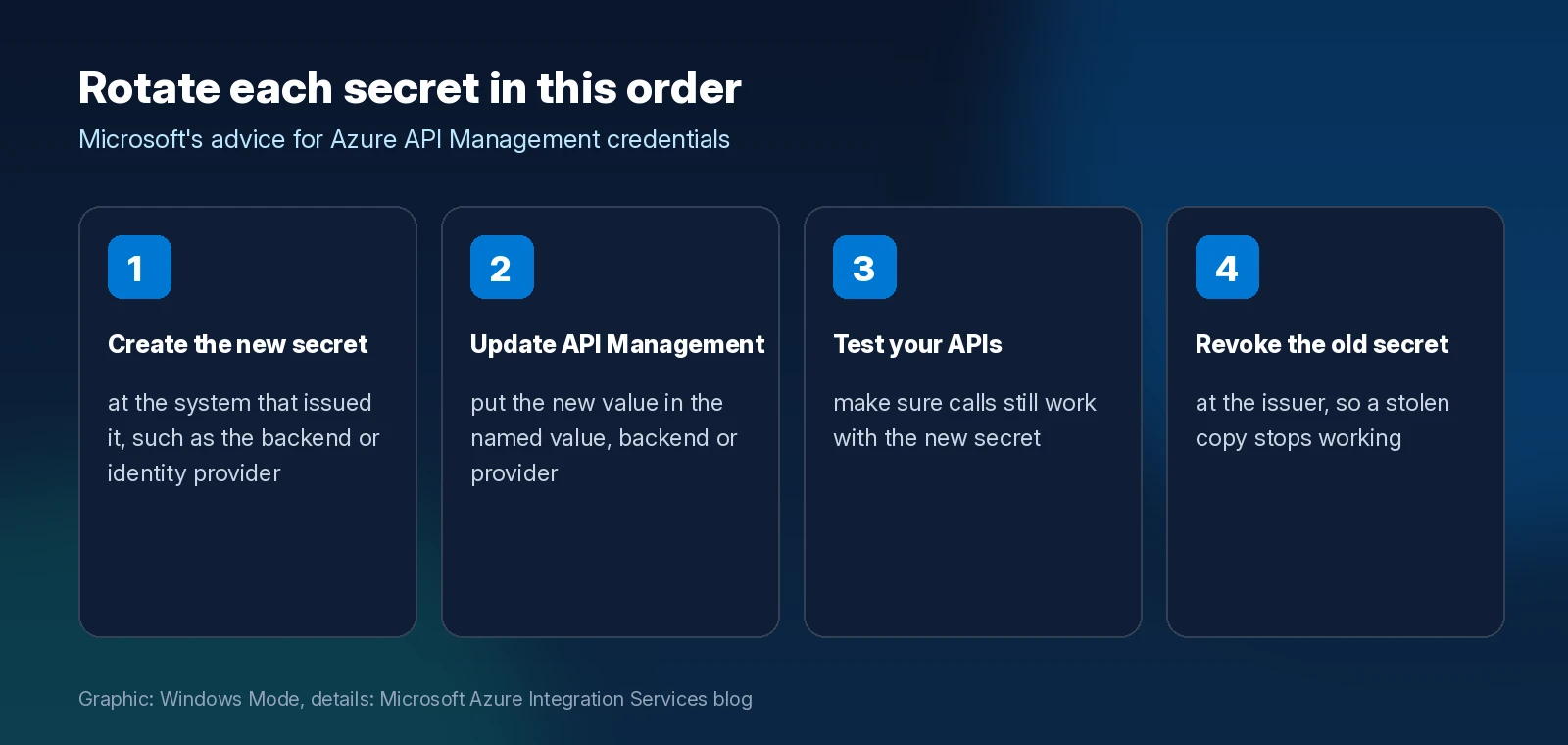
You’re finished when: every secret on your list has a new value at its issuer, your APIs pass testing, and every old secret has been revoked.
Look for signs someone used them
Microsoft asks affected customers to investigate suspicious activity and check whether their instances were accessed before the fix. Start with the sign-in and access logs of the systems those secrets unlock, going back to before November 19.
In their words
“If you run APIM, patching isn’t the end of it.”
Anders Kristiansen, cloud security researcher, as quoted by Network World
Kristiansen’s own rotation list adds two items that are easy to miss: app registration secrets and the Key Vault secrets APIM points to, plus the instance’s tenant access keys.
Do v2 or Consumption customers need to do anything?
Microsoft says those tiers are not affected. NSM’s broader advice still asks every APIM user to assume exposure and rotate secrets, so many security teams will rotate anyway as a precaution.
Is there a CVE for this flaw?
Not yet. Neither Microsoft’s advisory nor NSM’s notice includes a CVE identifier.
Related on Windows Mode
Source: Microsoft’s Azure Integration Services blog and Network World.
Discover more from Windows Mode
Subscribe to get the latest posts sent to your email.
















Add your first comment to this post