Has Microsoft walked away from Nscale’s Essex AI supercomputer? Yes, but only from that one site: Microsoft has ended its agreement for Nscale’s planned AI campus in Loughton, Essex, because grid power is not expected there until the 2030s.
Microsoft says its wider partnership with Nscale continues. Nothing changes for Azure customers today, because the Loughton site was never switched on. What has changed is the plan Microsoft announced in September 2025 to build what it called the UK’s largest supercomputer there.
The short version
- What ended: Microsoft’s deal to use the Loughton campus, planned for 23,040 NVIDIA GB300 GPUs.
- Why: UK Power Networks told Nscale it cannot supply enough power until the early to mid 2030s, according to The Guardian.
- What Microsoft says: “This decision relates to a single site.” The two companies still work together in other countries.
What exactly did Microsoft pull out of?
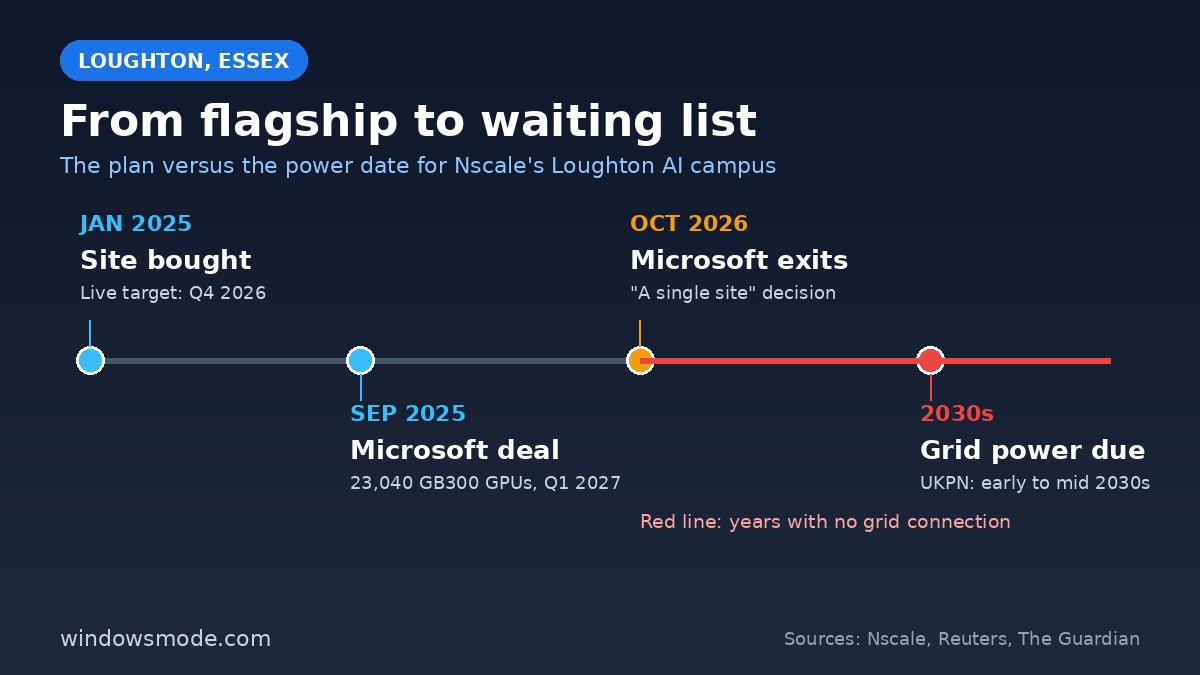
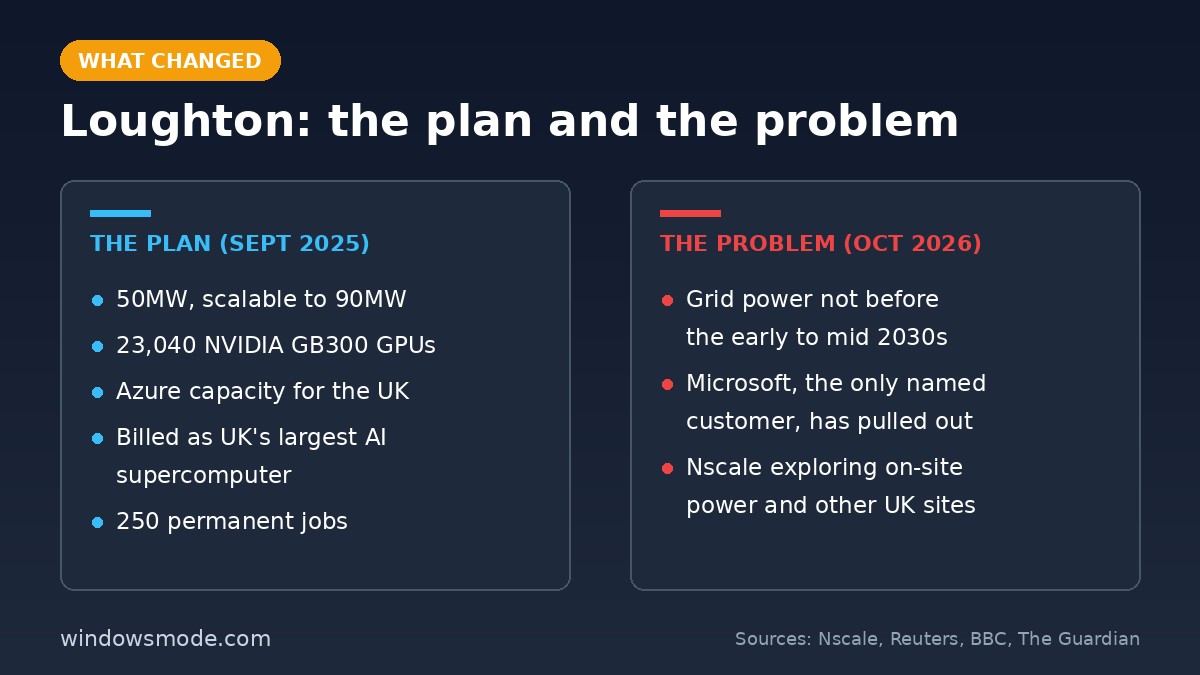
Nscale and Microsoft announced the Loughton commitment on September 16, 2025, during the US state visit to the UK. Nscale said the campus would deliver 50MW of AI capacity, scalable to 90MW, and initially house 23,040 NVIDIA GB300 GPUs delivered in the first quarter of 2027. It would help run Microsoft’s Azure services across the UK.
The Telegraph first reported that Microsoft had pulled out. Reuters then got a statement from Microsoft. A spokesperson said “this decision relates to a single site”, and the company said it remains committed to its partnership with Nscale, including building digital infrastructure and supporting AI growth around the world.
Why can’t the site get power sooner?
The local network operator, UK Power Networks, told Nscale the grid will not be able to supply enough electricity until the early to mid 2030s, The Guardian reports. The BBC says the site was due to receive its power supply at the end of this year.
Loughton is not a one-off. Reuters notes that queues for grid connections in Britain are delaying some data center projects by as long as 13 years. Nscale itself calls it a “London-wide grid issue”.
The timetable had already slipped before this week. Data Centre Review points out that Nscale originally targeted the final quarter of 2026, that planning delays pushed the schedule back, and that by July 2026 the proposed 90MW grid connection was reportedly running late.
“Our relationship with Microsoft remains strong and long-term, and this unfortunate London-wide grid issue has no impact on our other contracts. We remain committed to both the Loughton project and the UK, and we are exploring alternative power sources for the site, as well as other expansion sites in the UK.”
Nscale spokesperson, to Reuters
What happens to the Loughton site now?
Nscale says it is sticking with Loughton. According to The Guardian, the company has cleared the site, a former scaffolding yard, and is looking at generating power on site and at ways to speed up its grid connection. Data Centre Review adds that Nscale reportedly held talks with Bloom Energy about fuel cells, though neither company has announced a deal.
Microsoft was the anchor tenant and the only publicly announced customer for Loughton, The Guardian says. Finding a new one matters, because Nscale filed for a US stock market listing last month. Reuters says its contracted value has grown from $100 million to more than $103 billion in two and a half years, with Microsoft and Anthropic expected to be major customers.
Does this change Microsoft’s UK plans?
Microsoft has not said where the capacity planned for Loughton will go. It also has not said whether the change affects its wider UK spending. The BBC reports that Microsoft and Nscale are still working together on projects in Norway, Portugal and the US.
The bigger issue is that AI capacity can only be built as fast as power arrives. We covered the money side of that problem in our report on Gartner’s warning that AI data center spending will outrun revenue through 2030. For how Microsoft plans and runs its own fleet, see our look at Azure AI infrastructure from supply chain to fleet operations.
Background: the September 2025 deal
On the day of the Loughton announcement, Microsoft President Brad Smith said Microsoft would invest $30 billion in the UK from 2025 through 2028. That included $15 billion in capital spending on cloud and AI infrastructure, which he said would let Microsoft build the country’s largest supercomputer, with more than 23,000 NVIDIA GPUs, in partnership with Nscale.
Nscale first announced Loughton in January 2025 as part of a plan to invest in UK data centers. The BBC says Nscale pledged £2bn for the facility, which was expected to create 250 permanent jobs.
Sources: Microsoft and Nscale statements reported by Reuters, plus Nscale’s September 2025 announcement. Checked October 20, 2026.
Discover more from Windows Mode
Subscribe to get the latest posts sent to your email.














Add your first comment to this post