The Ultra Ethernet Consortium (UEC) released version 1.1 of its Ultra Ethernet specification on October 12, 2026. It is the first big feature update since the 1.0 spec landed in June 2025, and it pushes Ethernet deeper into AI data centers. The headline changes are support for scale-up networks (the links between GPUs inside a server), switches that do math on the data as it passes through, and congestion control you can reprogram in software. Microsoft, which runs some of the largest AI clusters in the world on Azure, is one of the consortium’s founding members.
What Is Ultra Ethernet, and Why a 1.1?
Background
The UEC was formed in July 2023 under the Linux Foundation. Its founding members were AMD, Arista, Broadcom, Cisco, Eviden, HPE, Intel, Meta and Microsoft. The goal is simple to state and hard to do: make plain Ethernet good enough for huge AI training and high-performance computing (HPC) clusters, where InfiniBand and proprietary links have long ruled.
Version 1.0 defined a new transport protocol, congestion control and a modern take on remote direct memory access (RDMA). Since then the group has shipped three point releases (1.0.1 to 1.0.3) with fixes and clarifications, according to its specification history. Version 1.1 is the first release that adds major new features.
Scale-Up Networking: Squeezing Bytes Out of Every Packet
Scale-Up
AI clusters use two kinds of networks. Scale-out networks connect servers across a cluster. Scale-up networks connect the accelerators inside one server or node, such as its GPUs. Scale-up traffic is made of huge numbers of small messages, so every byte of header and padding matters. In the UEC’s announcement, technical committee chair Tom Emmons calls scale-up support the most substantial part of the release.
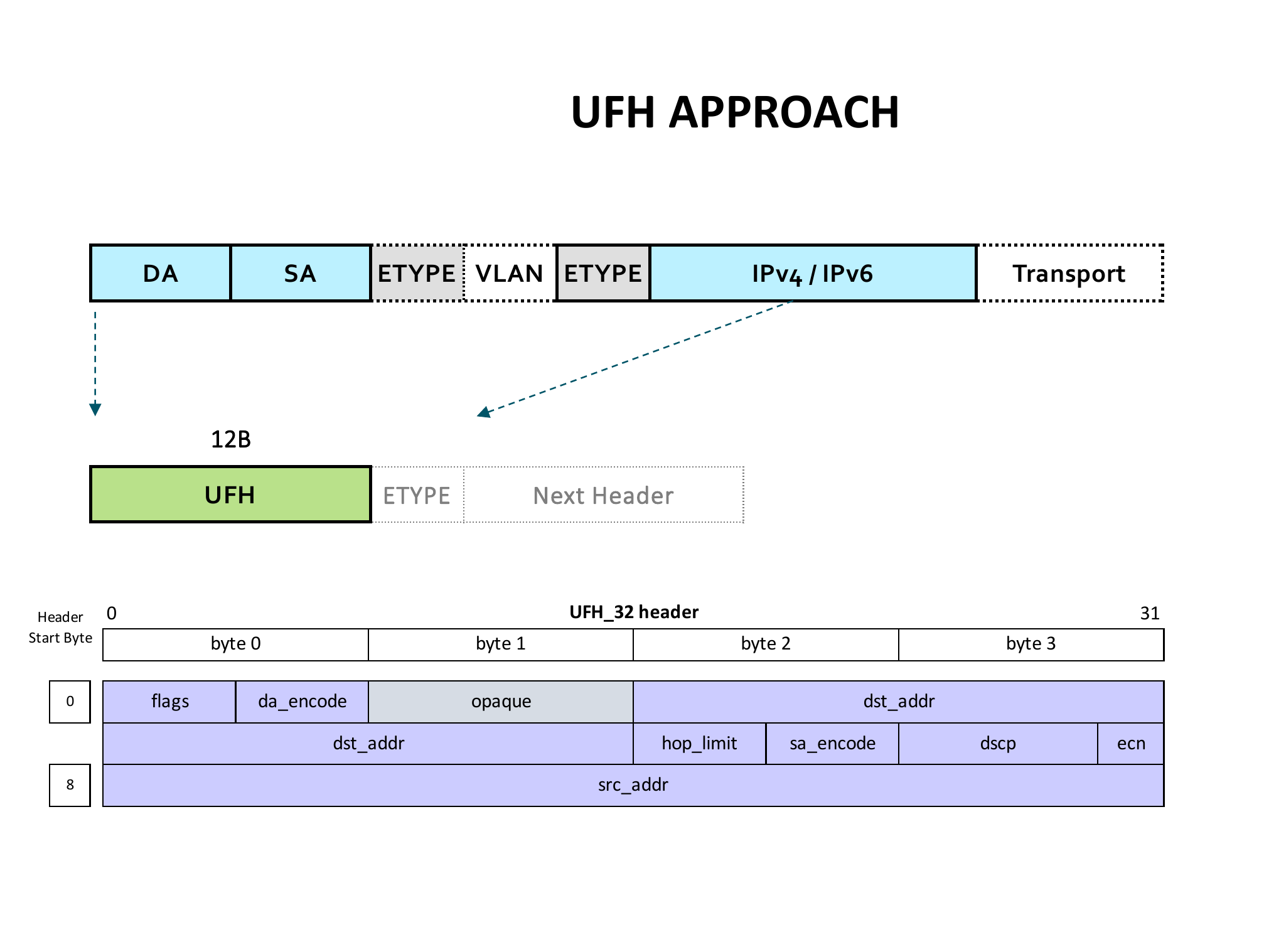
Header The Unified Forwarding Header
The new Unified Forwarding Header (UFH) sits on top of the regular Ethernet header and replaces the separate IP header. The UEC says this saves 20 bytes per packet compared with a traditional IP packet, while keeping full IP routing. It can also share a wire with normal Ethernet traffic, so it does not need a separate network.
Transport Unified Local Profile and Shorter Gaps
- Unified Local profile: A simplified transport for scale-up endpoints that supports write, read and atomic operations. Network World notes that requests can carry acknowledgment data for the other direction, which cuts down on extra packets. It is built for lossless fabrics using priority flow control (PFC) or credit-based flow control (CBFC).
- Reduced inter-packet gap: Ethernet inserts idle bytes between packets. An optional mode in 1.1 shrinks that gap, saving up to 11 bytes per packet.
The UEC is also working with the Open Compute Project (OCP) to bring these scale-up features into the next version of OCP’s Ethernet for Scale-Up Networking (ESUN) spec.
In-Network Collectives: Letting the Switch Do the Math
AI Training
When an AI model trains across many GPUs, they regularly need to combine their results. A common step is called all-reduce: every GPU sends its numbers, they get combined into one result, and every GPU gets that result back.
Done the traditional way, data crosses the network twice. The UEC’s example: to produce a 1 GB result, each endpoint has to send 2 GB. With In-Network Collectives (INC), the switch combines the data as it arrives and sends the result back, so each endpoint sends only 1 GB. The UEC says that means up to a 2x communication speedup, plus lower latency for small collective operations because data takes fewer hops.
Easier porting: 1.1 also adds a Verbs mapping (UET Verbs), more flexible memory mapping and synchronization groups. Together, the UEC says, these let existing RDMA applications move to Ultra Ethernet with fewer code changes.
Congestion Control Gets Better Signals and Software Updates
Congestion
Congestion control is how a sender decides how fast to transmit when links get busy. In 1.0, the main warning was an explicit congestion notification (ECN) mark, which is a single bit. It says a queue somewhere is filling up, but not where or how badly. The algorithm reacting to it was also fixed inside the network card (NIC).
CSIG Congestion Signaling
CSIG adds a small 4-byte or 8-byte tag to packets. Each switch along the path updates it with what it sees, such as queueing delay or available bandwidth. The receiver passes the worst value back to the sender, so the sender learns both how bad the congestion is and where it happened. UEC’s two built-in algorithms, NSCC and RCCC, now use this data. The same information is useful for network monitoring and troubleshooting, and the UEC is working with the IEEE to standardize CSIG further.
PCM Programmable Congestion Management
PCM gives NIC vendors a common language and set of APIs for writing congestion control and load balancing algorithms. Those programs are compiled to run on the endpoint, and because the APIs are standard, a custom algorithm can move to any NIC that supports PCM. “The goal of PCM is to ensure congestion control isn’t baked into the NIC, but instead fully software configurable,” Emmons told Network World, since AI workloads keep changing over a NIC’s lifetime.
When Will You See Ultra Ethernet 1.1 Hardware?
Next Steps
A spec is not a product. The UEC does not announce products itself, and it says support is up to its member companies. Version 1.1 does add the groundwork vendors need: a management plane (servers expose a Redfish data model, switches a YANG model) and compliance testing. Vendors self-certify by listing the features and profiles they support and running the UEC checklist tests.
Emmons believes every 1.1 feature needs some hardware support, but he expects companies to add it to existing hardware through software and firmware updates, because the work has been in progress for a while.
What this means for IT teams: most Windows Server shops and small businesses will not touch Ultra Ethernet directly. It matters if you plan or buy AI and HPC clusters, or rent GPU capacity from a big cloud. If that is you:
- Ask your NIC and switch vendors for their UEC 1.1 roadmap, and whether current gear will get it through firmware.
- Check compliance claims against the specific features and profiles a vendor says it supports, since certification is self-attested.
- Read the spec if you work on AI fabrics. The full UE Specification 1.1 is a free download from the UEC site.
Are you planning an AI cluster on Ethernet, or sticking with InfiniBand for now? Tell us in the comments.
Discover more from Windows Mode
Subscribe to get the latest posts sent to your email.















Add your first comment to this post