Key Points
- Next-gen local AI: Microsoft partners introduced Windows 11 Copilot+ PCs featuring the new NVIDIA RTX Spark superchip to process heavy AI models locally.
- Premium power at budget prices: Dell launched an updated XPS 13 starting at $699, expanding entry-level access to high-end hardware.
- New silicon tiers: Intel debuted Arc G-Series processors optimized for handheld gaming, while Qualcomm introduced the entry-tier Snapdragon C platform for students and small businesses.
What is changing in the Windows hardware ecosystem
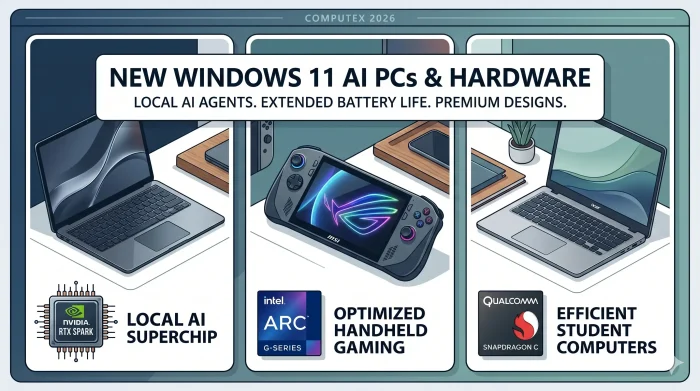
As reported by the official Microsoft Devices Blog at Computex 2026, major hardware manufacturers are launching a new wave of Windows 11 devices focused heavily on on-device AI performance, extended battery life, and more accessible price points.
The most significant shift comes from new silicon architecture. NVIDIA, in collaboration with MediaTek and Microsoft, introduced the RTX Spark. This Arm-based AI superchip delivers up to 1 petaflop of AI performance, allowing devices like the new Surface Laptop Ultra, ASUS ProArt P16, and MSI Prestige N16 Flip AI+ to run complex, multi-model AI agents locally without relying on cloud processing.
At the same time, processor manufacturers are filling critical market gaps:
- Intel Arc G-Series: Built on the Core Ultra Series 3 architecture, these processors are specifically engineered to maximize battery life and graphics performance in handheld gaming devices like the MSI Claw 8 EX AI+ and Acer Predator Atlas 8.
- Qualcomm Snapdragon C: A new entry-tier platform designed to bring quiet, efficient performance and all-day battery life to budget-conscious computers, debuting in the Acer Aspire Go 15.
- Dell XPS 13: Dell has aggressively re-priced its thinnest CNC aluminum laptop to start at $699, standardizing a 2.5K touchscreen and Wi-Fi 7.
How the new hardware compares
To help you understand where these new devices and chips fit into the market, here is a direct breakdown of the key announcements and their target audiences.
| Hardware / Silicon | Primary Focus | Key Specification | Best For |
|---|---|---|---|
| NVIDIA RTX Spark | Local AI, advanced creation, and gaming | Up to 1 petaflop of AI performance; 128GB unified memory | Developers, creative pros, and AI power users |
| Intel Arc G-Series | Handheld PC gaming optimization | XeSS 3 support; low-power core management | Mobile gamers looking for better AAA battery life |
| Qualcomm Snapdragon C | Affordable, efficient everyday computing | Cool-and-quiet architecture; budget price tier | Students, families, and basic small business tasks |
| Dell XPS 13 (2026) | Premium ultraportable accessibility | Starts at $699; 2.5K display and Wi-Fi 7 standard | General users wanting premium build quality for less |
Check our list of the best gaming laptops to buy right now
Why this matters for users
For creative professionals, the introduction of full-stack local AI engines means smoother processing on complex 3D scenes and 4K video timelines without latency or subscription cloud costs. High-end hardware options are also pushing display boundaries, such as the ROG Strix SCAR 18 featuring the first 18-inch 4K 240Hz Mini LED display.
For the average consumer, these updates signal that efficient, premium designs are becoming less expensive. Qualcomm’s entry into the budget space and Dell’s aggressive pricing on the XPS 13 mean you no longer have to pay massive premiums for all-day battery life and modern, lightweight builds. While the high-end RTX Spark devices will begin rolling out later this fall, the shift toward highly efficient, AI-capable silicon is now standard across the entire Windows ecosystem.
Read the original source at Microsoft Devices Blog.
Discover more from Windows Mode
Subscribe to get the latest posts sent to your email.